The R&D Tax Credit is back! Find out how the Big Beautiful Bill Act can fund your R&D. Learn More
%201.svg)

.svg)
.svg)
.svg)
Last Updated: August 2026
AI is unlikely to replace accountants because much of an accountant’s value comes from judgment, context, and client relationships, not simply preparing a return.
Where AI can make a much bigger difference is in the work surrounding that expertise.
Business tax preparation still involves collecting documents, organizing binders, rebuilding Excel workpapers, processing K-1s, reconciling book-to-tax differences, and moving approved information into tax software. AI agents can increasingly handle parts of that workflow while keeping accountants responsible for review, approval, and signoff.
That changes the AI conversation.
The question becomes less about whether AI can do an accountant’s job and more about what accountants can do when less of their day is spent preparing information.
The best place for AI isn't necessarily the work requiring the most judgment.
It's the work surrounding it.
Consider what happens before a business tax return is ready for review. Firms may need to:
Every one of these steps matters. But much of the process is structured, repetitive, and time-consuming.
That's exactly where AI can help.
Byron, for example, is built specifically around business tax preparation. Its agents can work across client documents, prior-year files, accounting systems, Excel workpapers, and tax software to prepare an engagement for review.
The accountant doesn't disappear from the process.
The nature of their involvement changes.
A useful way to think about AI in accounting is to separate preparation from judgment.
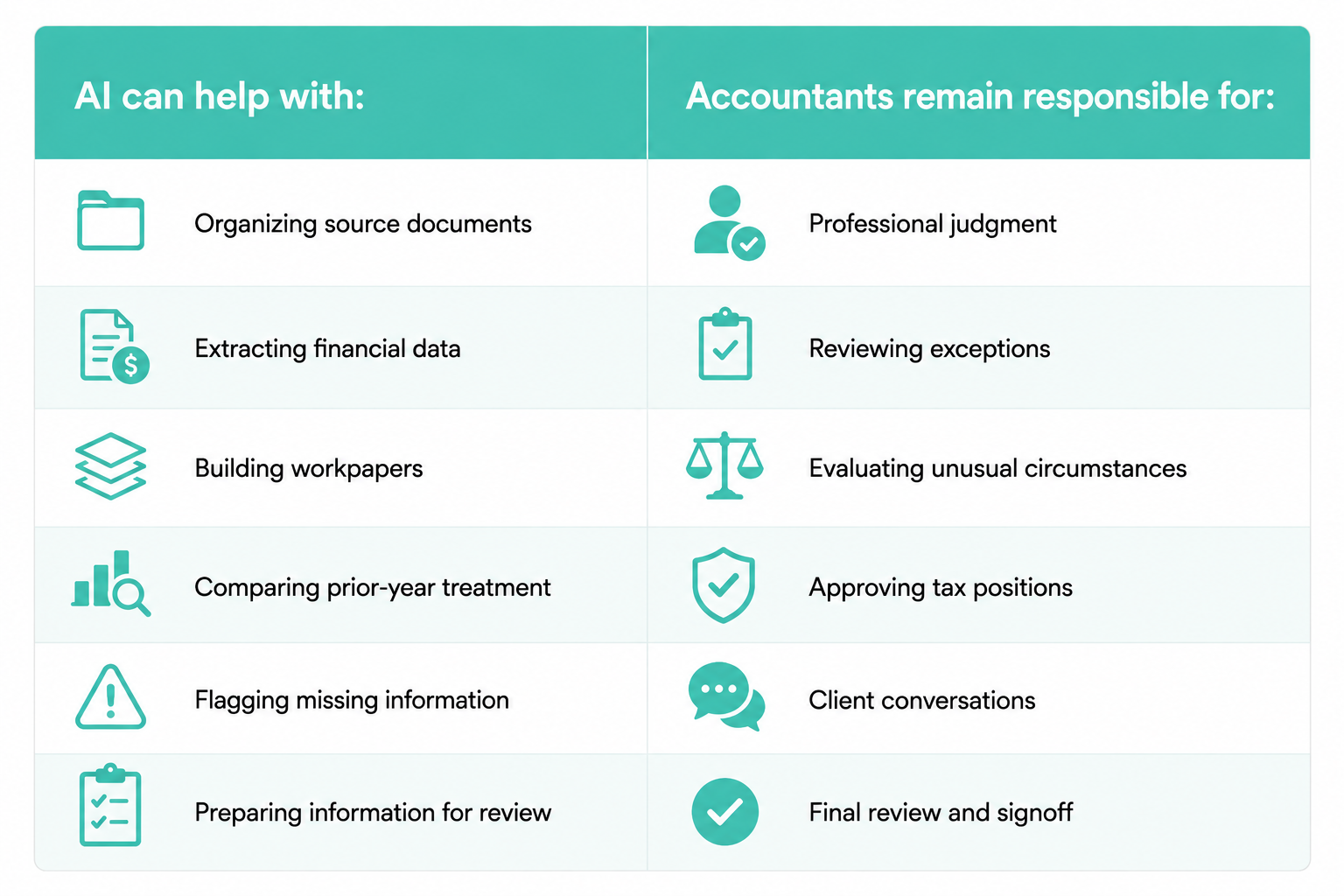
This division is important because accounting automation shouldn't mean blindly accepting whatever a model produces.
For example, Byron's workflow keeps CPAs in control. Agents prepare and suggest work, while reviewers can approve, override, and sign off. Outputs can also be traced back to source documents, with confidence scoring, exceptions, and audit trails designed to make automated work reviewable.
That's a very different model from asking AI a tax question and trusting the answer.
Speed isn't particularly useful if a reviewer has to independently verify everything an AI system produces.
For accounting firms, trust depends on being able to answer basic questions:
Where did this number come from?
What changed?
What did the system do?
Who approved it?
That's why useful accounting automation needs more than data extraction. Firms need source-linked outputs, approval workflows, exception handling, and records of changes.
Byron's approach reflects this. Its business-tax workflow records edits, comments, approvals, overrides, workbook updates, sync events, and exports, while keeping the reviewer responsible for decisions.
The goal isn't automation without oversight.
It's making the work easier to review.
This is where AI becomes much more interesting.
Saving time on tax preparation isn't only about getting returns out the door faster. It creates capacity that firms can use elsewhere.
An accountant may have more time to discuss:
Those conversations can happen before a decision is made, when there's still an opportunity to change the outcome.
That is fundamentally different from traditional compliance work, which often looks backward at transactions that have already occurred.
Potentially, yes.
As preparation becomes more efficient, the difference between simply producing a return and helping a client understand what to do next becomes more visible.
Take a company hiring engineers.
A tax return tells the company what happened financially during the prior year. A strategic conversation might uncover that some of those engineering activities could qualify for the R&D tax credit.
Or consider a company renovating a commercial building. Knowing about Section 179D before or during the project can lead to a very different conversation than discovering the incentive after construction is complete.
This is where accountants continue to provide something software cannot replicate easily: business context.
They know what the client is planning, what changed during the year, and which questions are worth asking.
More advisory time doesn't mean a CPA needs to become an expert in every corner of the tax code.
In fact, knowing when to bring in a specialist can be part of good advisory work.
Tax incentives can become highly technical. Areas such as:
may require engineering analysis, detailed eligibility reviews, specialized calculations, or additional documentation.
That's where a partner like TaxTaker can support the CPA-client relationship.
For example, a CPA may recognize that a manufacturing client has significantly increased engineering payroll. TaxTaker can then evaluate the underlying activities, calculate the potential R&D credit, and help document the claim while the CPA remains involved in the broader tax relationship.
Technology creates capacity.
Specialization helps firms use some of that capacity to uncover opportunities for clients.
AI alone doesn't turn someone into a better advisor.
But time helps.
A CPA who has more capacity can ask questions that might not fit into a rushed tax-season conversation:
Those questions can reveal tax implications long before they appear on a return.
The technology isn't providing the relationship.
It's creating more room for one.
Not every AI product solves the same problem, and firms shouldn't evaluate accounting AI solely on how much it claims to automate.
A more useful evaluation starts with the workflow.
Replacing every existing system may create more work than it removes. Tools that integrate with existing document storage, accounting systems, Excel, and tax software can reduce that friction.
Source links, exceptions, confidence indicators, and audit histories help reviewers understand how an output was produced.
Automation should support professional judgment rather than bypass it.
Tax engagements aren't static. Clients send revised trial balances, late K-1s, and corrected documents. The workflow needs to account for those changes.
Tax firms handle highly sensitive financial information, so security, data location, access controls, encryption, and model-training policies deserve the same scrutiny as functionality.
For example, Byron states that it uses U.S.-only hosting, encryption in transit and at rest, does not train models on customer data, and is SOC 2 Type II compliant.
These questions are more useful than simply asking, "Does your firm use AI?"
The more realistic answer is that AI will change which parts of accounting require human time.
Technology can increasingly handle the structured work surrounding preparation. Accountants still need to evaluate exceptions, understand context, make professional judgments, communicate with clients, and take responsibility for the final work.
Byron describes its own philosophy simply: agents prepare; reviewers decide.
That distinction may prove more important than the broader debate over whether AI can "do accounting."
Will AI replace accountants?
AI is better positioned to automate parts of tax preparation than to replace the judgment, accountability, and client relationships accountants provide.
Where can AI help CPA firms today?
Business-tax workflows such as document organization, PBC requests, workpaper preparation, K-1 processing, book-to-tax reconciliation, and review preparation are increasingly suitable for AI-assisted workflows.
What happens to the time firms save?
That depends on the firm. One of the biggest opportunities is using additional capacity for client service, proactive planning, and higher-value advisory work.
AI can now assist with significant portions of the preparation workflow, including document processing, workpaper generation, book-to-tax adjustments, and preparing information for review. Human review and professional judgment remain critical.
Not necessarily. Byron, for example, is designed to keep Excel central to the workflow and export approved information into the firm's existing tax software rather than replacing the tax engine.
Automating repetitive preparation tasks can reduce manual workload and help teams focus their limited time on exceptions, review, client communication, and higher-value work.
AI may help surface information, but determining eligibility for specialized incentives often requires additional analysis. Credits such as the R&D tax credit can depend on the company's activities, expenses, documentation, and specific facts.
Firms should evaluate where data is stored, whether client information is used for model training, how data is encrypted, who can access it, and whether actions are auditable. Security should be part of the purchasing decision, not an afterthought.
AI doesn't need to replace accountants to fundamentally change accounting.
Removing even part of the manual work surrounding tax preparation can change how professionals spend their limited time. Instead of rebuilding workpapers or moving information between systems, more of that time can go toward reviewing exceptions, speaking with clients, and thinking ahead.
That's ultimately where Byron and TaxTaker intersect.
Byron focuses on making the business-tax preparation workflow more efficient while keeping the CPA in control. TaxTaker works with CPAs and businesses when specialized tax incentive opportunities require deeper analysis.
Neither replaces the accountant.
They help accountants spend more of their time where their expertise matters.
For firms looking to reduce manual business-tax preparation, Byron provides AI agents designed around the workflows CPA teams already use.
And when additional capacity leads to conversations about R&D tax credits, Section 179D, cost segregation, or other tax incentive opportunities, TaxTaker can provide the specialized support needed to evaluate them.
Book a call with TaxTaker to discuss how your firm can identify more tax-saving opportunities for clients without having to build every specialty in-house.

Ari Salafia is CEO of TaxTaker. She's passionate about helping innovative companies and founders save millions on taxes through government incentive programs. Through her work at TaxTaker, Ari continues to inspire and empower businesses to maximize their savings potential.

.svg)


