The R&D Tax Credit is back! Find out how the Big Beautiful Bill Act can fund your R&D. Learn More
%201.svg)

.svg)
.svg)
.svg)
Last Updated: September 2026
To support an R&D tax credit claim, a company needs records showing what research it performed, why the activities qualify, who performed the work, and how the Qualified Research Expenses (QREs) were calculated. There is no single required “R&D document.” Instead, businesses can rely on technical records, project documentation, payroll data, contracts, invoices, accounting records, and other evidence created during the normal course of business.
The IRS requires taxpayers to maintain records in enough detail to substantiate that the expenses claimed are eligible for the credit. For tax years beginning after 2025, documentation is even more important because many taxpayers must also report QREs by business component in Section G of Form 6765.
The goal is not to create paperwork for the sake of paperwork. It is to create a clear trail from the research your team performed to the expenses included in the credit calculation.
R&D tax credit documentation needs to support two sides of the claim: why the activities qualify and how the expenses were calculated.
A practical way to think about it is:
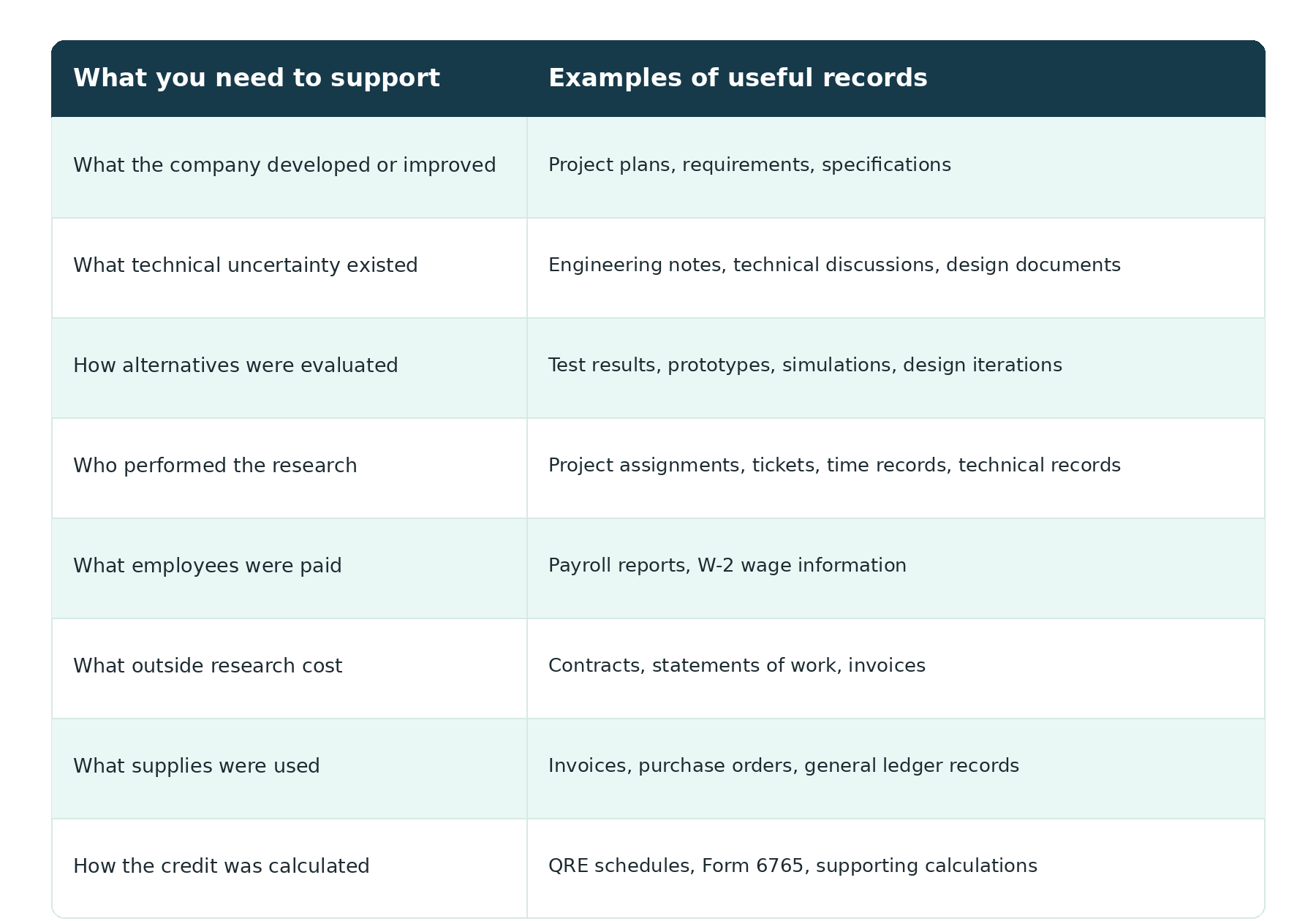
The strongest documentation connects these records rather than treating them separately.
For example, payroll records may establish that an engineer earned $150,000 during the year. They do not, by themselves, establish what portion of that employee's time was spent performing qualified research.
Project and technical records help make that connection.
For each business component included in the claim, your records should help explain what was being developed or improved, what was uncertain, and how your team tried to resolve that uncertainty.
A useful project record should answer questions like:
These questions map closely to the requirements for qualified research under Section 41.
Compare these two descriptions:
“Developed new platform functionality.”
Versus:
“Engineers evaluated three data-processing approaches because the existing architecture could not meet the required processing speed. The team built and tested alternative database and caching configurations before selecting the final architecture.”
The second description does a much better job of showing the technical uncertainty and experimentation behind the work.
Technical records created during the normal development process can provide some of the strongest support for an R&D tax credit claim.
Depending on the business, those records might include:
The IRS's audit guidance specifically points to contemporaneous records such as project authorizations, budgets, work orders, project summaries, progress reports, meeting minutes, testing data, contracts, and other records describing research activities.
No individual Jira ticket, Git commit, or design document automatically proves that research qualifies. The value comes from how the records work together to show what the technical problem was and what your team did to solve it.
This is particularly relevant for software companies, where much of the evidence may already exist inside development tools rather than a formal R&D report.
There is no single IRS-mandated time-tracking system that every business must use. What matters is whether the company has sufficient evidence to substantiate the qualified services performed and the wages included in the credit.
Contemporaneous time records can provide useful support, but they are not the only possible evidence. Depending on the company, support may also come from:
The IRS's audit guidance specifically identifies employee names, wage amounts, departments, job titles, job descriptions, and percentages of annual wages among the information that may be reviewed. It also states that the IRS does not have to accept estimates when documentation exists that can verify actual QREs.
The practical takeaway is simple: do not wait until tax season and assign an unsupported percentage to every engineer.
If a company concludes that an employee spent 70% of their time performing qualified services, there should be a reasonable basis for that 70%.
No. Job titles can provide context, but the R&D tax credit follows the activities performed, not the title on an employee's email signature.
Two software engineers with identical titles may have completely different qualified percentages.
One might spend most of the year developing and testing a new system architecture. The other might primarily handle routine maintenance and customer-specific implementations.
The same applies to executives.
A CTO who directly supervises qualified research may perform qualified services. A senior executive who only provides general management oversight should not automatically be included simply because they oversee the technical organization.
Form 6765 itself distinguishes wages for people conducting qualified research from wages for direct supervision and direct support of qualified research.
If your company includes contract research expenses in its QREs, keep records showing who performed the work, what they were hired to do, and how much you paid.
Useful records can include:
A payment to a software developer, engineering firm, laboratory, or technical consultant does not automatically qualify.
The underlying activities and contractual arrangement still need to satisfy the applicable Section 41 rules.
The IRS's substantiation guidance specifically identifies contracts, contractor amounts, categories of work, and agreements for third-party research among records relevant to an examination.
If supplies are included in the credit calculation, the company should be able to connect those costs to qualified research. Useful records might include:
Again, the department making the purchase does not determine qualification.
Buying a material for the engineering department does not automatically make it an R&D expense. The company should be able to show how that supply relates to the qualified research being claimed.
The IRS's audit guidance specifically identifies supply categories, amounts, and their connection to the general ledger as information relevant to substantiating QREs.
For tax years beginning after 2025, Section G of Form 6765 is required for many taxpayers, subject to specific exceptions in the current IRS instructions. Section G requires more detailed reporting of QREs by business component.
For taxpayers required to complete Section G, the IRS uses an 80%/Top 50 approach.
A taxpayer generally reports business components in descending order of QREs until it has either:
Remaining business components are then reported in aggregate.
For each reported business component, Form 6765 can require information such as:
The IRS also instructs taxpayers to use a business-component name or identifier that is consistent with the books and records used to substantiate the qualified research and associated QREs.
That is an important documentation change.
If engineering calls a project "Project Atlas," finance calls it "Platform 2.0," and the tax workpapers call it "Software Development Project A," connecting the records becomes unnecessarily difficult.
No. The current Form 6765 instructions provide exceptions to the Section G requirement.
For tax years beginning after 2025, Section G generally does not have to be completed if:
Because those thresholds and requirements are specific, businesses should check the current Form 6765 instructions for the tax year being filed rather than assume Section G applies to every R&D credit claim.
Even when a company qualifies for an exception, project-level documentation is still useful for substantiating the underlying credit.
Yes. An amended return claiming or increasing a Section 41 research credit has additional information requirements.
Current IRS Form 6765 instructions require a research credit refund claim to provide information about:
The IRS's procedures for R&D credit refund claims have changed over time, so businesses considering an amended claim should review the current requirements rather than rely on an older credit study or checklist.
The larger lesson is that an amended claim should be built from the underlying projects and activities, not simply from a revised credit number.
The best time to document R&D is while the research is happening.
Waiting until tax season creates two problems. First, people forget why technical decisions were made. Second, records can disappear as employees leave, projects are archived, contractors finish their work, or companies change software systems. A simple quarterly process can prevent much of that:
This does not mean asking engineers to write tax memos every quarter. It means preserving the evidence the company is already creating.
One of the biggest mistakes is starting with the expense and working backward. For example, a company sees that it spent $2 million on engineering payroll and decides that 80% must be R&D. A better process starts with the work:
What did we develop? → What qualified? → Who worked on it? → Which expenses relate to that work?
Other common documentation mistakes include:
The IRS emphasizes contemporaneous documentation in its examination guidance and notes that taxpayers must substantiate both qualified activities and the expenses associated with them.
A strong claim should create a logical trail:
Business component → technical uncertainty → experimentation → employees and expenses → QRE calculation → Form 6765
Good documentation cannot guarantee that a return will not be examined. It can, however, put a company in a much stronger position to explain and support the credit if the IRS asks questions.
Under Section 6001 and the related regulations, taxpayers are responsible for keeping records sufficient to establish the amounts reported on their returns. IRS research-credit guidance similarly states that records should be detailed enough to substantiate the eligibility of the expenditures claimed.
The objective is not to produce the longest possible R&D study report.
A 100-page report filled with generic descriptions is not necessarily stronger than a shorter study tied directly to contemporaneous project records.
Specific, consistent, traceable documentation is more useful than volume.
State R&D credits may require additional documentation because state rules can differ from the federal credit, particularly when determining where qualified research was performed.
A company with a distributed engineering team might have employees conducting qualified research in several states. The federal analysis can provide a starting point, but the company may need to separate QREs by location when evaluating state credits.
For example, if a business has developers in California, engineers in Texas, and employees in New York, simply knowing the company's total federal QREs may not be enough.
You may also need to know which employees performed which activities in which state.
A good R&D tax credit file should make the claim traceable from the tax return back to the underlying technical and financial records. A practical file could look like this:
The exact records will look different for a SaaS company, manufacturer, engineering firm, or biotech company.
The standard is not whether every company has the same file. The question is whether your records support your company's actual claim.
The easiest R&D documentation process connects the people who know what happened with the people who know what it cost.
Technical teams can answer:
Finance can answer:
Neither team necessarily has the full picture alone.
A short quarterly R&D review between finance and technical leaders can therefore be more useful than trying to reconstruct twelve months of research during tax season.
Good R&D tax credit documentation does not start with a report. It starts with keeping a clear record of the research your company is already performing.
Identify the business components being developed or improved. Document the technical uncertainty and experimentation involved. Connect that work to the employees, contractors, supplies, and other eligible expenses included in the credit calculation.
Then make sure the final QRE calculation and Form 6765 can be traced back to those records.
That approach makes the claim easier for your CPA to review, easier to maintain from year to year, and easier to explain if questions arise later.
TaxTaker helps businesses identify qualified activities, calculate QREs, and organize the technical and financial support behind their R&D credit.
Schedule a call with TaxTaker to discuss your R&D tax credit documentation process.
Useful documentation can include project plans, technical specifications, test results, engineering records, source-control history, payroll records, employee allocations, contracts, invoices, and accounting records. The specific records depend on the research being performed and the expenses included in the claim.
The IRS does not prescribe one universal daily time-tracking system for every R&D credit claimant. Businesses do, however, need sufficient records to substantiate qualified services and wage QREs, and unsupported estimates can create substantiation problems.
Yes. Jira tickets, Git history, pull requests, testing records, and similar development records can help show what technical work was performed, when it occurred, and who was involved. They should be considered alongside the company's financial and other project records rather than treated as proof of qualification by themselves.
Section G reports research information at the business-component level. For tax years beginning after 2025, it is required for many taxpayers, subject to IRS exceptions, and uses the 80%/Top 50 methodology for reporting business components and their associated QREs.
Current IRS requirements for applicable Section 41 refund claims include identifying the relevant business components and research activities and reporting total qualified employee wage, supply, and contract research expenses. Businesses should check the current IRS procedures when preparing an amended claim because these requirements have changed over time.
Businesses should retain sufficient documentation for as long as it may be needed to support the return and credit under the applicable record-retention and statute-of-limitations rules. The appropriate period can depend on the taxpayer's circumstances, so businesses should coordinate their retention policy with their CPA or tax advisor.
.png)
Rachel Darrough is a Sr. R&D Manager with nearly 10 years of experience conducting federal and state R&D tax credit studies across various industry types, e.g., manufacturing, software, engineering, and construction. Rachel received a Bachelor's Degree in Managerial Finance and brings a strong technical foundation to evaluating qualified research activities, technical uncertainty, and experimentation under IRC §41. At Tax Taker, Rachel manages R&D engagements by collaborating with technical and finance teams to identify qualified expenditures, substantiate eligibility, and optimize credit outcomes. She applies an analytical approach to documentation and methodology while ensuring compliance with IRS guidance. Rachel is committed to helping clients leverage innovation-driven incentives to reduce tax liability and reinvest in continued R&D.

.svg)


