The R&D Tax Credit is back! Find out how the Big Beautiful Bill Act can fund your R&D. Learn More
%201.svg)

.svg)
.svg)
.svg)
Last Updated: September 2026
The R&D tax credit can help startups and small businesses reduce federal taxes based on money they already spend developing or improving products, software, processes, and technology. You do not need a laboratory, a patent, or even a profitable business to potentially qualify.
Under Internal Revenue Code Section 41, the credit is based on qualified research expenses connected to activities that meet specific research requirements. For eligible Qualified Small Businesses, or QSBs, up to $500,000 of the credit per year can be elected against payroll taxes, allowing some startups to benefit before they owe federal income tax.
For founders, the key questions are straightforward: Does our work qualify? Which expenses count? How much could the credit be worth? How can we use it? And what do we need to document?
This guide walks through the entire process.
The federal R&D tax credit is a tax incentive under IRC Section 41 for businesses that incur qualified expenses while conducting qualified research in the United States.
Despite the name, "R&D" does not mean a company has to operate a formal research department. A startup developing software, testing a new manufacturing process, designing hardware, improving system performance, or solving an engineering problem may be performing qualified research.
The federal R&D credit is claimed using Form 6765, Credit for Increasing Research Activities. Form 6765 is also used to make certain elections related to the credit, including the payroll tax election available to eligible QSBs.
That distinction matters for startups. A company can be spending heavily on innovation long before it becomes profitable enough to owe income tax.
Can Startups and Small Businesses Claim the R&D Tax Credit?
Yes. The federal R&D tax credit is not limited to large corporations, and small businesses can qualify based on the same underlying Section 41 research rules.
What changes for certain startups is how the credit can be used.
A profitable small business may use an allowable research credit against federal income tax liability. A younger business that qualifies as a QSB may instead elect to use some or all of its research credit against certain employer payroll taxes, subject to the applicable limits.
There are two separate questions businesses need to consider when evaluating the R&D tax credit:
A startup does not automatically qualify for the credit because it is new, innovative, or venture-backed. Its actual activities and expenses still need to meet the tax rules.
Qualified research generally must satisfy what is commonly called the Four-Part Test under Section 41.
The research should relate to developing or improving the function, performance, reliability, or quality of a business component.
A business component can include a product, process, computer software, technique, formula, or invention.
The research must fundamentally rely on principles of the physical or biological sciences, engineering, or computer science.
For a software startup, for example, this could involve computer science or engineering principles used to address scalability, architecture, performance, security, or another technical challenge.
At the beginning of the research, the company should be uncertain about its capability or method for developing or improving the business component, or about the appropriate design.
The key consideration is not whether the project was difficult, but whether the technical team encountered and worked to resolve genuine technical uncertainties during development.
Substantially all of the research activities must constitute elements of a process of experimentation designed to evaluate alternatives.
That could involve:
The IRS applies the qualified-research requirements separately to each business component.
Many startups perform potential R&D as part of ordinary product development rather than through a department explicitly called "Research & Development."
For example, potentially qualifying work may include:
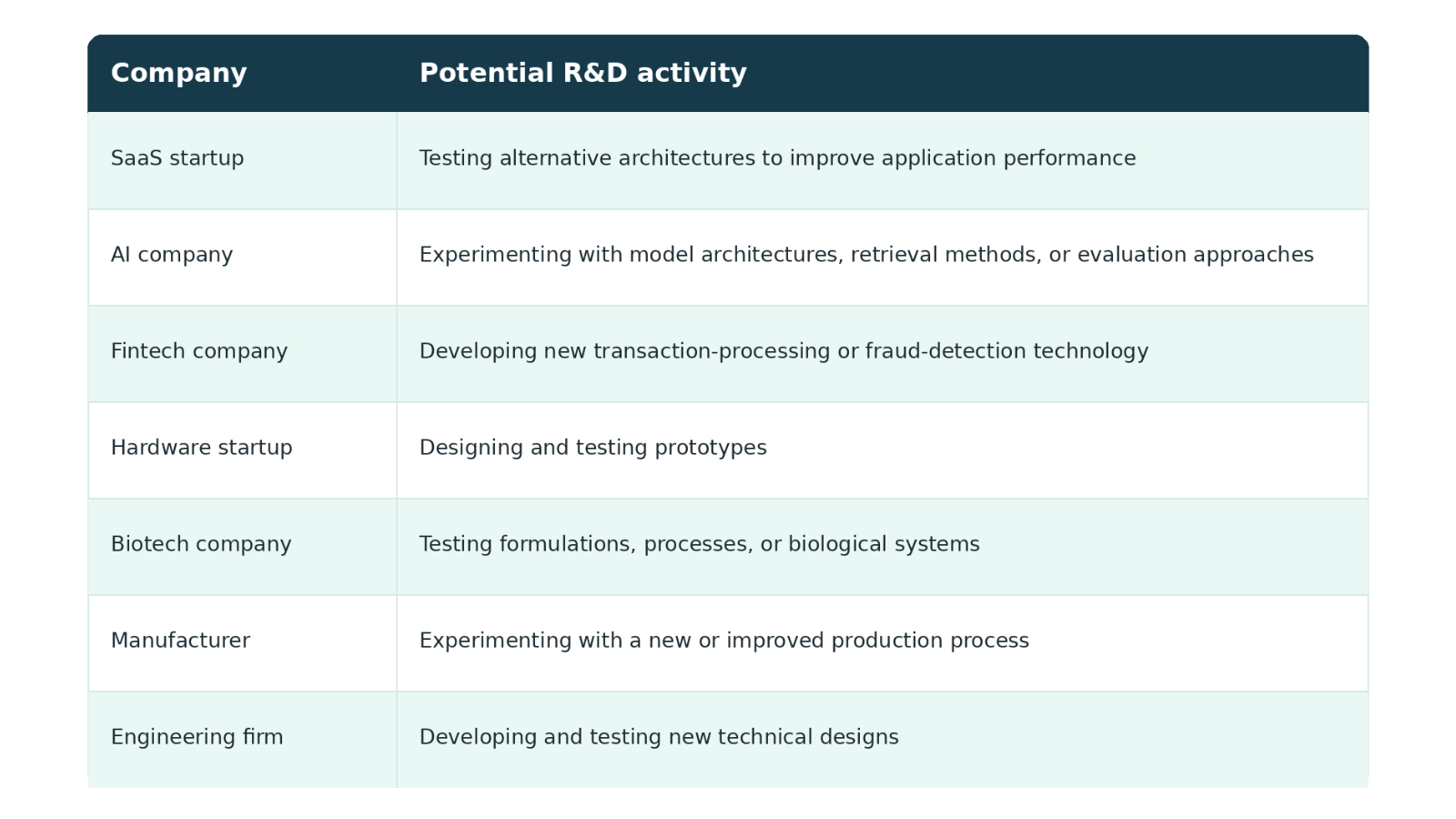
The activity still needs to satisfy Section 41. Merely calling a project "innovative" does not make it qualified research.
This is particularly important for software and AI companies. Developing technology may qualify, but routine configuration or simply using commercially available technology generally does not become qualified research just because the underlying product uses AI or sophisticated software.
Not every development expense belongs in an R&D tax credit claim.
Section 41 specifically excludes certain activities, including research conducted after commercial production, adaptation of an existing business component to a particular customer's requirements, duplication of an existing business component, certain surveys and studies, research outside the United States, research in the social sciences, arts or humanities, and certain funded research.
In practice, companies should be cautious about automatically treating activities such as these as qualified:
The distinction is usually what the team was actually trying to solve and whether experimentation was required, not the name of the department doing the work.
Once qualified research activities have been identified, the next step is determining the associated Qualified Research Expenses, or QREs.
The major federal QRE categories include employee W-2 box 1 wages for qualified services, supplies used in qualified research, certain amounts paid for qualified research performed by third parties, and certain computer rental or lease costs. Form 6765 separately captures these categories in calculating the credit.
For many startups, wages are the largest category.
A software company might have engineers, developers, technical founders, or other employees who spend some or most of their time conducting, directly supervising, or directly supporting qualified research.
But being an engineer does not automatically make 100% of someone's salary qualified.
The company needs to determine what portion of the employee's work relates to qualified activities.
They can. A founder's wages may be included when the founder performs qualified services and the compensation otherwise meets the applicable wage requirements.
This can matter for technical founders who are directly involved in architecture, engineering, product experimentation, prototyping, testing, or other qualified research.
The key is the work performed.
A CEO who spends most of the year fundraising, selling, hiring, and managing the company should not automatically have their entire salary treated as a QRE simply because they have a technical background. A CTO-founder who spends significant time directly developing and testing technology may have a much stronger case for including an appropriate portion of wages.
The same activity-based analysis should be used for every employee.
Certain contract research expenses can qualify, but companies should examine both the activities performed and the terms of the arrangement.
Paying a developer, engineer, laboratory, or technical consultant does not automatically make the expense a QRE. The underlying work still needs to constitute qualified research, and Section 41 contains specific rules governing contract research. Startups using outsourced development teams should therefore preserve:
This is particularly important when a startup relies heavily on contractors instead of W-2 employees.
The R&D credit is not simply a fixed percentage of everything a company spends on development.
Companies generally calculate the federal credit using either the Regular Research Credit method or the Alternative Simplified Credit (ASC), depending on their circumstances.
Under the ASC, the calculation generally compares current-year QREs with 50% of the average QREs from the prior three tax years. The applicable Form 6765 calculation then applies the statutory rate.
That means two companies spending the same amount on R&D can generate different credits. Factors that affect the calculation can include:
For planning purposes, it is better to calculate the credit from actual QRE data than to assume every company receives the same percentage.
Yes. This is one of the most important features of the credit for early-stage companies.
Normally, an income tax credit is most immediately valuable when a company has income tax liability. But Section 41(h) allows a Qualified Small Business to elect a portion of its research credit against payroll taxes instead.
Under the current IRS rules, a QSB generally must have:
This is why the payroll tax provision is particularly relevant to young companies that are investing in engineering before becoming profitable.
An eligible QSB can elect up to $500,000 per year of its research credit for use against payroll taxes, subject to the amount of credit actually generated and other applicable limitations.
The election is made on Form 6765 and must generally be made on a timely filed original income tax return, including extensions. The payroll tax benefit is then calculated through Form 8974 and claimed on the applicable employment tax return, such as Form 941.
Since 2023, the credit is applied first against the employer share of Social Security tax, up to $250,000 per quarter, with remaining eligible credit applied against the employer share of Medicare tax. Unused amounts can carry forward to later quarters.
Imagine a young SaaS startup spends heavily on U.S.-based engineering and generates a $75,000 federal R&D credit. The company is still operating at a tax loss, so there is little immediate income tax liability for the credit to offset.
If it satisfies the QSB requirements and properly makes the payroll tax election, that $75,000 may instead reduce qualifying employer payroll tax obligations over subsequent quarters.
The company does not need to wait until profitability to begin realizing the benefit.
For a startup managing its runway, the timing of the credit can be just as important as the amount itself.
No. The payroll tax election is designed for qualified young businesses and has a limited window.
Under the current Form 6765 instructions, a company cannot make the election for a tax year if it made a payroll tax credit election for five or more preceding tax years.
That means founders should not think of the payroll offset as a permanent startup benefit.
As a company matures, exceeds the QSB requirements, or becomes profitable, its R&D credit strategy can change. Credits may become more relevant against income tax rather than payroll tax.
The basic process starts with identifying the research and ends with the appropriate tax filings.
A typical workflow looks like this:
Form 6765 is the core federal research-credit form. For tax years beginning after 2025, its Section G business-component reporting requirements also apply to many filers, subject to exceptions in the current instructions.
This makes project-level organization increasingly useful even for smaller companies.
A startup should be able to support what qualified, who performed the research, and how the claimed expenses were calculated.
Useful records often already exist in the company's normal workflow.
For a software startup, for example, that could include:
The goal is not to create paperwork for its own sake. The records should create a clear connection between the company's technical experimentation and the expenses included in the credit.
Section 41 and Section 174A affect R&D differently, and startups should consider them together.
Section 41 governs the R&D tax credit and determines which research activities and expenses can generate the credit.
Section 174A governs the tax treatment of domestic research or experimental expenditures.
For tax years beginning after December 31, 2024, Section 174A generally allows taxpayers to deduct domestic research or experimental expenditures when incurred. Taxpayers may instead elect to capitalize and amortize those domestic expenditures over a period of at least 60 months.
These categories are related but not identical. A company should not assume that every cost treated as an R&E expenditure under Section 174A automatically becomes a QRE for the Section 41 credit.
That is why R&D credit planning should be coordinated with the company's broader treatment of research expenses.
Often, yes. Many states offer their own research incentives, and a company may potentially qualify for a state R&D credit in addition to the federal credit.
But state rules are not uniform.
A state may use different:
For startups with remote teams, location can become particularly important. A company headquartered in one state may have qualified researchers working in several others.
That means founders should evaluate where the research actually occurs, not simply where the company is incorporated.
Ideally, before tax season.
The easiest R&D claims to support are generally those where companies identify potentially qualified work during the year rather than reconstructing everything months later.
A lightweight quarterly process can be enough:
This also makes the credit easier to incorporate into financial planning.
For startups, an R&D credit is not simply a tax-return number. If the company qualifies for the payroll offset, it can affect actual cash outflows during the year.
The biggest mistakes usually come from either assuming the company does not qualify or assuming everything technical qualifies.
A strong claim sits between those extremes.
Common problems include:
For startups especially, the best approach is usually conservative but complete: identify all potentially qualifying projects, apply the tax rules consistently, and document the resulting expenses.
Prior-year research credits may sometimes be addressed through an amended return, but the rules are more demanding than simply adding Form 6765 to an old return.
The IRS has specific information requirements for Section 41 refund claims, including information about the relevant business components, research activities, and qualified expense categories.
The available years also depend on the applicable statute of limitations and the company's filing circumstances.
So a startup that discovers it performed qualified research several years ago should first determine which years remain open and whether the documentation supports a claim.
The R&D credit should evolve with the company.
An early-stage startup may care primarily about the payroll tax offset because it has significant engineering payroll but little taxable income.
Later, the company may begin generating taxable income and use credits differently. It may expand into additional states, hire distributed teams, acquire another company, or significantly increase its research spending.
That creates a natural progression:
Treating R&D credits as an annual planning process rather than a one-time filing exercise makes that transition much easier.
It depends on the amount of qualified research being performed, the available QREs, the potential credit, and the work required to support the claim.
A startup with a meaningful technical payroll may have a very different opportunity than a small business with one employee occasionally improving an internal process.
The first step therefore should not be "claim the credit."
It should be:
Does enough qualified research exist to justify a closer look?
From there, the company can estimate QREs and the potential credit before deciding how much time to invest in a full study.
That is exactly where a preliminary eligibility review or R&D credit estimate can be useful.
Potentially, yes. Having no revenue does not by itself prevent a company from generating an R&D credit if it has qualified research expenses. Whether the company can use the credit immediately through the payroll tax election depends on the QSB requirements and its payroll tax position.
Yes. A company does not need to be profitable to generate an R&D tax credit. Eligible QSBs may elect up to $500,000 per year of research credit against qualifying employer payroll taxes instead of waiting to use the credit against income tax.
The IRS's QSB test generally requires less than $5 million in gross receipts for the current tax year and no gross receipts before the five-tax-year period ending with that year. The payroll tax election also cannot be made if the business made the election for five or more preceding tax years.
Software development can qualify when the activities satisfy Section 41, including the technological and experimentation requirements. Routine maintenance, straightforward implementation, and other activities without qualifying technical experimentation should not automatically be included.
The R&D credit under Section 41 and the treatment of domestic research expenditures under Section 174A are separate but coordinated tax provisions. For tax years beginning after 2024, Section 174A generally permits current deductions for domestic R&E expenditures, while Section 280C affects the interaction between deductions and the research credit.
The election is made through Form 6765 with the startup's timely filed income tax return. The elected payroll credit is then calculated through Form 8974 and claimed through the applicable employment tax return, such as Form 941. Any applicable state credits will have their own forms and rules regarding if the credit can offset state payroll taxes.
Start with the work your company is already doing.
Look at the products, software, processes, or technologies your team tried to develop or improve during the year. Identify where the outcome or method was technically uncertain and where your team tested different ways to solve the problem.
Then connect those activities to the people and expenses involved.
From there, you can determine whether the potential credit is meaningful, whether the payroll tax election is available, what documentation is needed, and whether state credits could add additional value.
TaxTaker helps startups and small businesses evaluate qualified research, calculate R&D credits, prepare supporting documentation, and coordinate the credit with their CPA and payroll process.
Book a call with TaxTaker to see what your company's R&D activity could qualify for.

Ari Salafia is CEO of TaxTaker. She's passionate about helping innovative companies and founders save millions on taxes through government incentive programs. Through her work at TaxTaker, Ari continues to inspire and empower businesses to maximize their savings potential.

.svg)


