The R&D Tax Credit is back! Find out how the Big Beautiful Bill Act can fund your R&D. Learn More
%201.svg)

.svg)
.svg)
.svg)
Last Updated: August 2026
Federal and state R&D tax credits can often be claimed for the same underlying research activity, but they are calculated separately and can produce very different credit amounts.
At the federal level, the Alternative Simplified Credit (ASC) generally equals 14% of current-year qualified research expenses above 50% of the average QREs from the prior three tax years. States can apply their own rates, calculation methods, eligible expense rules, and geographic restrictions.
For example, California's ASC calculation uses a 3% rate instead of the federal 14% rate and only applies to qualified research conducted in California. That means a company should not simply calculate its federal R&D credit and assume the state benefit will be a fixed percentage of that number. In the next section, we’ll show what the difference can look like in practice.
Companies can calculate the federal research credit using the Regular Credit method or elect the Alternative Simplified Credit on Form 6765. For many businesses, the ASC provides a more straightforward calculation because it relies on recent qualified research expenses rather than the historical information required under the Regular Credit method.
The federal ASC formula is: 14% × (Current-Year QREs − 50% of Average QREs for the Previous Three Years)
As an example. Assume a SaaS company reports the following qualified research expenses:
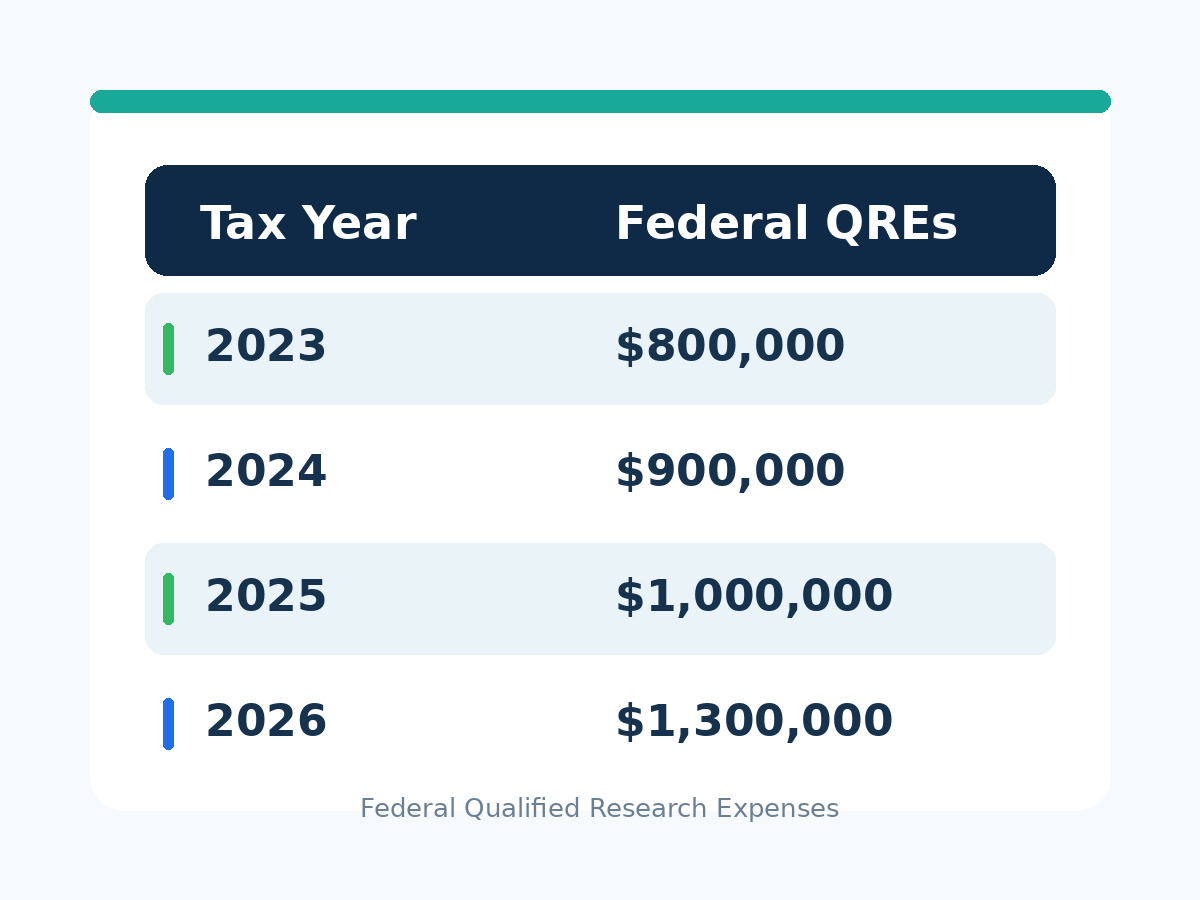
The three-year average of the QREs is: ($800,000 + $900,000 + $1,000,000) ÷ 3 = $900,000
Half of that amount is: $900,000 × 50% = $450,000
The company's excess QREs are therefore: $1,300,000 − $450,000 = $850,000
Applying the federal ASC rate: $850,000 × 14% = $119,000
The company's illustrative federal R&D credit is $119,000 before other applicable limitations or elections.
The actual credit claimed can differ based on the company's facts, tax position, Section 280C election treatment, controlled-group rules, and other requirements.
A state R&D credit is not simply an additional federal credit.
Each state establishes its own rules. Depending on the jurisdiction, differences can include:
Location becomes especially important.
A business might have $1.3 million of federal QREs but only $600,000 associated with research performed in a particular state. The state calculation would generally begin with the expenses eligible under that state's rules, not the company's total nationwide R&D spend.
California provides a useful example of how dramatically state and federal calculations can differ.
For taxable years beginning on or after January 1, 2025, California allows taxpayers to elect a modified ASC. The California ASC equals 3% of QREs exceeding 50% of the average QREs for the preceding three taxable years. California's research credit applies to qualified research conducted only in California.
Let's return to our SaaS company.
Assume part of its federal research activity occurs in California:
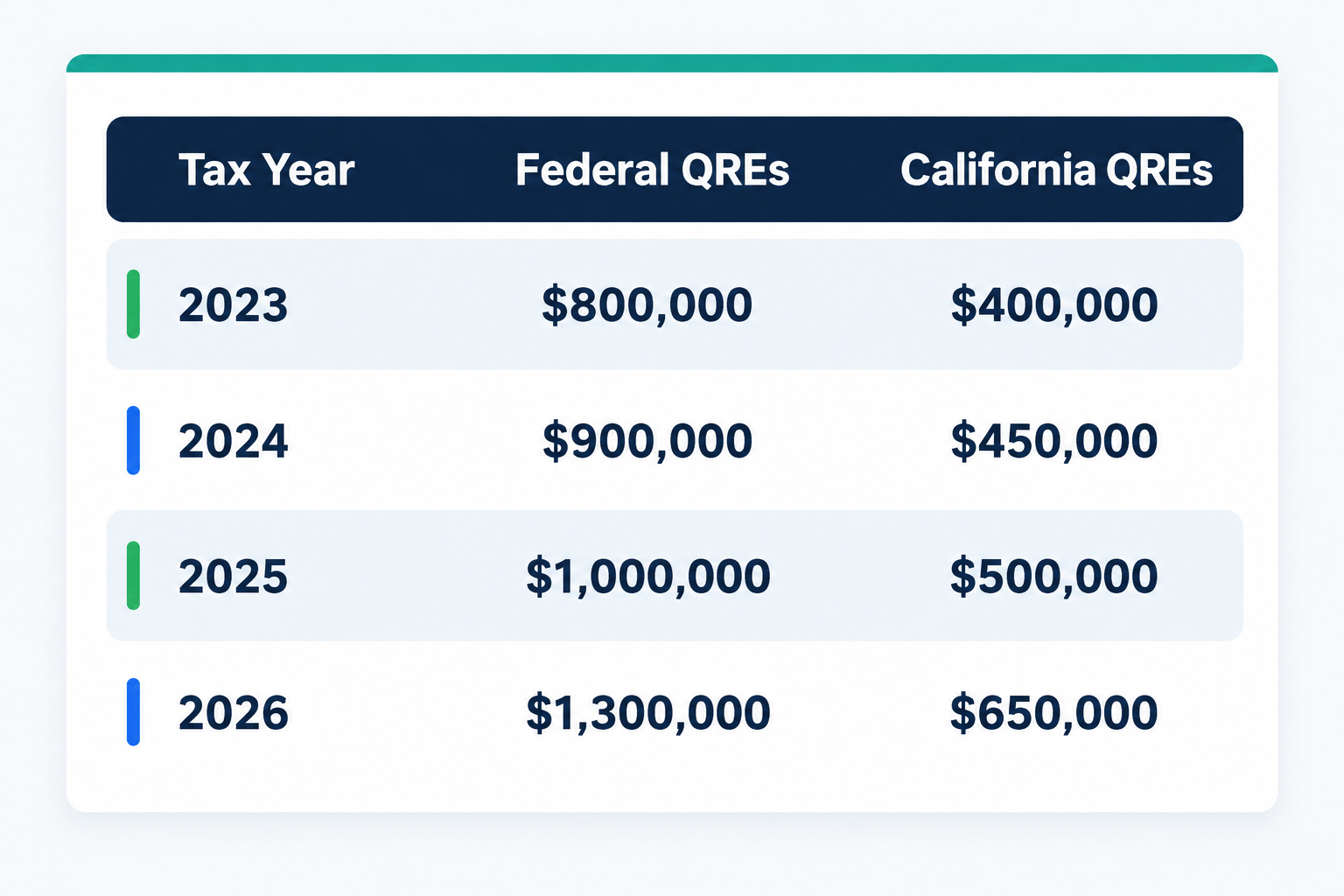
The California three-year average is: ($400,000 + $450,000 + $500,000) ÷ 3 = $450,000
Half of the average is: $450,000 × 50% = $225,000
That leaves: $650,000 − $225,000 = $425,000
Apply California's 3% ASC rate: $425,000 × 3% = $12,750
The company's illustrative California research credit is $12,750, subject to the state's other applicable rules and limitations.
In our simplified example:
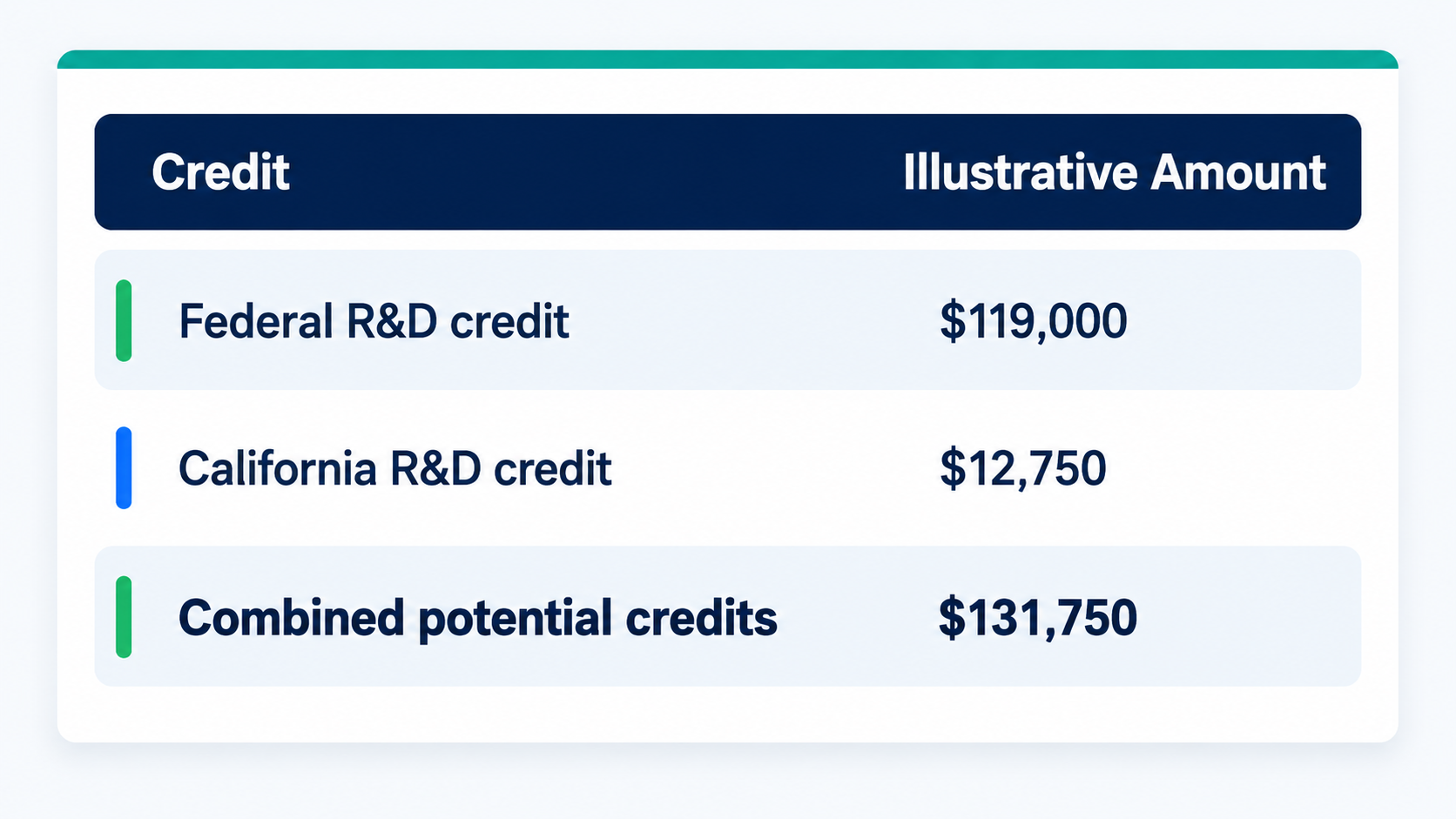
The important takeaway isn't the $131,750 itself. These are simplified numbers intended to demonstrate the mechanics.
The important takeaway is that one set of research operations can potentially create separate federal and state tax benefits, but each credit must be calculated under its own rules.
That's why state credits should be evaluated separately rather than estimated by applying an arbitrary percentage to the federal result.
Yes, the same underlying research activities may support both federal and state R&D credits when the applicable requirements are satisfied.
However, state credits generally focus on research performed within that particular jurisdiction. California, for example, limits qualified research and basic research to research conducted in California.
This makes employee and project location increasingly important for companies with multi-state teams.
A company with engineers in California, Texas, New York, and Florida cannot assume all federal QREs will qualify for a California credit simply because the company's headquarters are there.
Accurate location data can determine whether a company captures state R&D credits at all.
Finance departments should be able to connect qualifying costs with where the underlying research occurred. Depending on the business, useful records may include:
This becomes particularly important for remote and multi-state companies.
A strong federal R&D study can establish the foundation, but state-level analysis adds another layer: Where did the research actually occur?
One common mistake is assuming the state calculation mirrors the federal calculation. It may not.
Another is using the company's entire federal QRE pool when only a portion of those expenses relate to research performed in the state. This can create an inaccurate estimate and potentially an unsupported claim.
Companies should also avoid assuming that every state follows the same election, carryforward, refundability, or filing rules. California illustrates the point well. Its ASC rate is 3%, while the federal ASC rate is 14%. California also requires its own R&D Credit Form 3523 to calculate and claim the research credit.
Start tracking location before tax season. A company with a multi-state engineering department should know not only who performed qualifying work, but where that work was performed. A practical process might look like this:
This approach makes state credits part of the R&D study rather than an afterthought.
The federal R&D credit is calculated on IRS Form 6765, Credit for Increasing Research Activities. For tax years beginning after 2025, the IRS also requires Section G business-component reporting for many taxpayers, although certain qualified small businesses and smaller filers are exempt from that requirement.
State reporting depends on the jurisdiction. California taxpayers, for example, generally use R&D Credit Form 3523, to apply the Research Credit to the state tax return.
This is another reason companies should evaluate federal and state credits together while still treating them as separate calculations.
Can businesses claim both federal and state R&D tax credits?
Potentially, yes. Businesses conducting qualified research in states with their own R&D programs may generate state credits in addition to the federal research credit.
Are federal and state R&D credits calculated the same way?
Not necessarily. States can establish different rates, expense requirements, calculation methods, and filing rules.
What matters most for multi-state businesses?
Tracking where qualified research occurs. Federal QREs may span the United States, while state credits generally depend on research performed within the applicable jurisdiction.
It varies by each state. California specifically states that a taxpayer does not need to claim the federal research credit to claim California's research credit.
No. Under the ASC, 14% applies to QREs exceeding 50% of the average QREs for the prior three tax years, not simply to all current-year R&D spending. The Regular Credit provides a different calculation method.
They can. Because state programs may limit eligible expenses to research performed within the state, the location where employees conduct research can affect which state credits are available.
No. For taxable years beginning on or after January 1, 2025, California's modified ASC uses a 3% rate, while the federal ASC generally uses 14%.
The federal research credit is calculated using IRS Form 6765. California uses Form 3523 for its research credit.
Federal and state R&D credits can reward the same broader investment in innovation, but that doesn't make them interchangeable.
The federal R&D credit calculation looks at qualified U.S. research expenses under IRC Section 41. State programs introduce another set of rules, often including where the research was conducted, which expenses qualify, and how the credit itself is calculated.
For a company operating in multiple states, that distinction can translate into additional tax savings that a federal-only analysis would miss.
The best approach is to calculate the federal opportunity first, map qualified activity by location, and then evaluate each applicable state program individually.
TaxTaker helps companies calculate federal R&D tax credits and identify state-level opportunities that may increase the total value of their claim. For multi-state businesses, that includes reviewing where qualifying activity occurs and applying the appropriate state rules rather than relying on a federal-only estimate.
Book a call with TaxTaker to evaluate your federal and state R&D credit opportunities and understand what your qualified research spending could be worth.
.png)
Rachel Darrough is a Sr. R&D Manager with nearly 10 years of experience conducting federal and state R&D tax credit studies across various industry types, e.g., manufacturing, software, engineering, and construction. Rachel received a Bachelor's Degree in Managerial Finance and brings a strong technical foundation to evaluating qualified research activities, technical uncertainty, and experimentation under IRC §41. At Tax Taker, Rachel manages R&D engagements by collaborating with technical and finance teams to identify qualified expenditures, substantiate eligibility, and optimize credit outcomes. She applies an analytical approach to documentation and methodology while ensuring compliance with IRS guidance. Rachel is committed to helping clients leverage innovation-driven incentives to reduce tax liability and reinvest in continued R&D.

.svg)


