%201.svg)
Industry:
Technology:
Federal R&D Credit:
$142,100 in Payroll Tax Offset
State R&D Credit:
Total R&D Credits:
Defense AI Autonomy Startup Captures $173K in R&D Credits for Multi-System Coordination Platform
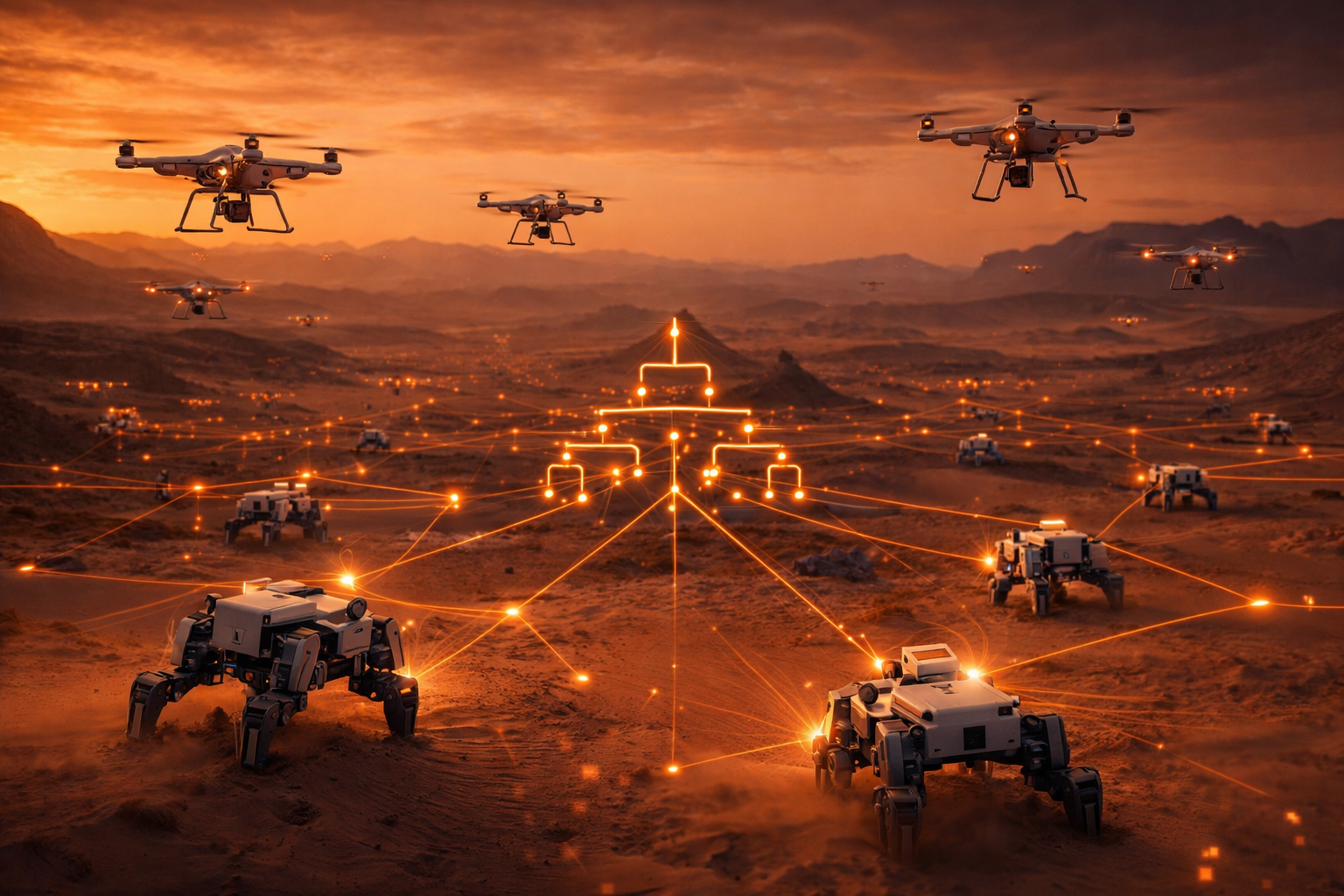
A Los Angeles-based defense technology startup founded by veterans of the aerospace, defense innovation, and autonomous systems industries has built a hardware-agnostic AI intelligence stack that enables autonomous teaming, real-time adaptive decision-making, and multi-sensor fusion across heterogeneous fleets of unmanned aerial, ground, and maritime systems. The company's software operates as a cross-platform intelligence layer, allowing military and commercial operators to define mission intent and have their robotic systems coordinate, learn, and adapt without manual oversight capabilities that have been proven through active U.S. Department of Defense contract work and exercises with multiple service branches. TaxTaker evaluated the company's engineering activities to identify qualifying R&D work for federal and state tax credit purposes.
TaxTaker's defense technology specialists conducted a comprehensive review of the company's software development activities, identifying qualifying research work across reinforcement learning algorithm development for autonomous behavior training, multi-robot coordination and swarm intelligence system engineering, multi-sensor fusion architecture for communications-degraded environments, cross-platform hardware abstraction layer development, and real-time mission planning and adaptive response software. Given the inherent technical uncertainty in training autonomous systems to perform reliably in uncontrolled, contested environments, each engineering activity demonstrated a strong process of experimentation consistent with IRS credit qualification standards.
The analysis identified $142,100 in qualifying federal R&D expenses and $31,700 in state-level eligible costs, resulting in a combined R&D Tax Credit of approximately $173,800. These credits provided important capital efficiency for a capital-light software company operating in the defense sector, supporting continued platform development and the onboarding of new DoD and commercial robotics partners. The engagement illustrates that defense AI software companies even those in stealth or early commercial phases can access significant R&D tax benefits tied to their ongoing technical innovation.


.svg)


.svg)
